
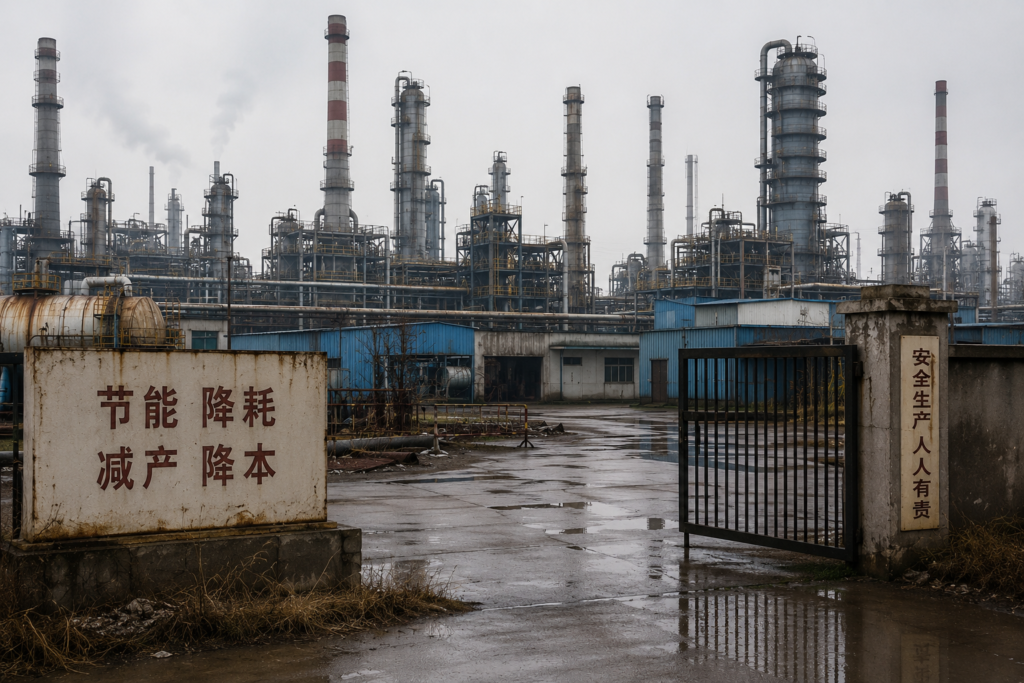
China’s energy sector is once again drawing global attention as the country’s independent refining segment experiences one of its sharpest operational slowdowns in nearly a decade. Recent developments indicate that China’s teapot refineries, widely recognized as the backbone of the country’s independent crude processing industry, have reduced refinery operations to their lowest levels since 2017. This development is far more significant than a temporary industrial slowdown. It reflects deeper structural changes taking place inside the world’s second-largest economy, signaling evolving demand patterns, regulatory tightening, supply chain pressures, and broader shifts impacting the global energy market China continues to influence. For energy analysts, commodity traders, and businesses dependent on stable petroleum markets, the decline in China refineries activity represents an important indicator of changing global energy dynamics.
China’s refining sector has historically played a central role in balancing global oil demand, particularly through the contribution of smaller independent refiners commonly referred to as teapot refineries. These facilities have traditionally responded aggressively to fluctuations in crude pricing and market opportunities, often operating outside the strategies employed by state-owned energy giants. Their sudden decline in refinery capacity utilization therefore carries implications extending far beyond domestic industrial output.
Understanding the Role of Teapot Refineries in China’s Energy System
To understand why this development matters, it is important to examine the strategic position teapot refineries occupy within China’s petroleum ecosystem. Unlike major state-controlled refining corporations, teapot refineries are privately operated or independently managed facilities concentrated largely in Shandong Province, a region that has become one of the most important refining hubs in Asia. These independent refineries China depends on have historically contributed significantly to domestic fuel production, supplying diesel, gasoline, petrochemical feedstocks, and industrial petroleum products to both domestic consumers and export markets.
For years, these facilities operated as highly flexible market participants capable of rapidly increasing or reducing production based on pricing opportunities and import economics. Their operational independence often allowed them to respond faster than state-run enterprises, creating an important balancing mechanism inside China’s broader crude oil refining system.
When teapot refineries begin significantly reducing output, analysts typically interpret it as a signal that broader market conditions have shifted in ways making production less economically attractive.
That appears to be precisely what is happening now.
Several overlapping factors are contributing to the sharp decline in refinery operations across China’s independent refining sector. One of the most immediate pressures comes from weakening domestic fuel demand. China’s economic recovery has been uneven across several industrial sectors, resulting in slower-than-expected energy consumption growth. Manufacturing output, freight transportation activity, and industrial fuel demand have all shown signs of moderation, reducing pressure on refiners to maintain aggressive production levels.
At the same time, global crude oil prices remain a major factor influencing profitability calculations for refiners. Higher feedstock acquisition costs can compress margins substantially, especially for smaller operators without the financial flexibility enjoyed by state-backed energy companies. When crude becomes expensive while refined product demand remains soft, many independent facilities choose to scale back operations rather than operate under shrinking profitability conditions.
This creates an increasingly difficult economic environment for independent refiners already operating in highly competitive domestic markets.
The current slowdown reflects broader market caution.
Production economics have become significantly less favorable.
Another major factor driving operational cuts involves China’s evolving energy policy framework. Over recent years, Beijing has steadily introduced stricter regulatory oversight targeting environmental compliance, fuel quality standards, emissions control measures, and tax enforcement within the refining industry.
Historically, some teapot refineries operated with greater flexibility than larger state-owned enterprises, benefiting from regulatory gaps that allowed aggressive expansion. That environment is changing rapidly as Chinese authorities seek tighter control over industrial emissions, fuel production quality, and overall energy sector efficiency.
Environmental enforcement campaigns have increasingly pressured smaller operators to invest heavily in cleaner processing infrastructure and upgraded compliance systems. Facilities unable to meet stricter standards often face production restrictions or reduced operating quotas, directly limiting refinery capacity utilization.
This regulatory tightening reflects a broader shift inside China’s industrial policy.
Efficiency and environmental compliance are increasingly prioritized over pure production growth.
The refining industry is undergoing structural transformation.
Profitability remains one of the strongest drivers determining refinery behavior, and current refining margins have become increasingly unfavorable for smaller operators. Independent refiners generally purchase crude oil on narrower margins than state-controlled enterprises, making them particularly vulnerable during periods of price volatility.
When international oil prices rise while domestic fuel prices remain constrained by market competition or regulatory pricing structures, refining margins compress rapidly. Independent operators then face difficult choices between operating at reduced profitability or temporarily cutting production to limit financial losses.
The current decline in China refineries activity suggests many operators increasingly view reduced throughput as financially safer than maintaining normal production volumes under unfavorable market conditions.
Margin pressure has become an important market signal.
Smaller refiners remain especially exposed.
Economic caution now dominates production decisions.
The current system, with a capacity of 300,000 barrels per day, will be expanded to support 1.5 million barrels per day, significantly boosting the field’s productivity and overall output.
The slowdown across China’s teapot refineries may begin influencing domestic petroleum supply conditions if reduced operations persist over extended periods. Lower refining throughput can eventually tighten supply availability for diesel, industrial fuels, transportation fuels, and petrochemical feedstocks supporting broader industrial production.
Although China maintains significant refining capacity through large state-owned operators, independent refineries often play an important stabilizing role during periods of fluctuating demand. Their flexibility historically allowed rapid production adjustments that helped balance regional supply conditions.
Reduced activity among independent operators may therefore concentrate production responsibility more heavily within state-controlled energy companies.
This shift could gradually reshape market competition.
Smaller operators may lose influence over time.
The domestic energy market may become increasingly centralized.
The sharp decline in China’s teapot refineries to their lowest operational levels since 2017 represents far more than a temporary industrial adjustment. It reflects a combination of weakening domestic fuel demand, compressed refining margins, regulatory tightening, evolving energy policy priorities, and broader structural transformation occurring within the world’s second-largest economy.
Because China remains central to global crude oil refining and international energy consumption patterns, these operational cuts carry implications affecting global oil markets, supply chains, industrial production economics, and long-term commodity pricing expectations worldwide.
For businesses monitoring international energy markets, this development serves as a reminder that refinery operations are not isolated industrial events. They often reveal larger economic transitions unfolding beneath the surface.
China’s refining industry is entering a new phase of transformation.
And the global energy market will feel the effects.
© 2026 Mana Global. All rights reserved.