
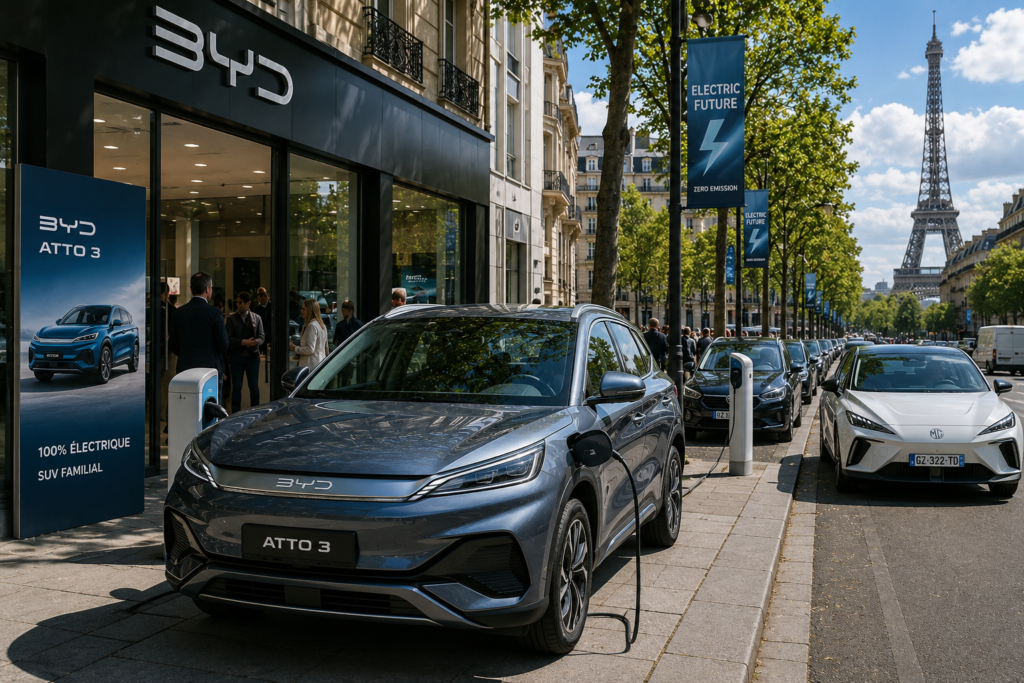
Europe’s transition toward electric mobility is entering a defining phase as consumer adoption accelerates faster than many analysts initially projected. Across major European economies, electric vehicle registrations continue rising as governments push aggressive decarbonization strategies, consumers increasingly embrace battery-powered transportation, and automotive manufacturers intensify their race toward electrification. At the same time, a second development is reshaping the competitive landscape in ways that traditional European automakers can no longer ignore. Chinese electric vehicle manufacturers are rapidly expanding their presence across European markets, bringing competitive pricing, increasingly sophisticated technology, and aggressive international growth strategies that are challenging long-established automotive leaders. The accelerating conversation around Europe EV boom and Chinese EV brands reflects more than a shift in consumer preference. It signals a structural transformation in global automotive competition, industrial supply chains, and the future balance of power within the electric vehicle sector.
Europe has positioned itself as one of the most ambitious regions pursuing transportation electrification, yet this transition is occurring alongside intensifying competition from manufacturers operating outside traditional Western automotive centers. The result is a rapidly evolving market environment where technological leadership, manufacturing efficiency, pricing strategy, and supply chain control increasingly determine competitive advantage.
The European automotive sector is undergoing one of the most significant industrial transformations in its modern history. Electric vehicles have moved well beyond niche adoption stages and are increasingly becoming a central pillar of long-term transportation strategy across the continent. Consumer demand continues rising as electric models become more accessible, charging infrastructure improves, and environmental awareness increasingly influences purchasing behavior.
Several European countries have implemented ambitious regulatory frameworks designed to accelerate the transition away from internal combustion engines. Policy support ranging from tax incentives and consumer subsidies to emissions standards and future combustion engine phase-out targets has created favorable market conditions supporting widespread electric vehicle adoption.
As these policies continue shaping consumer behavior, automakers operating in Europe face growing pressure to accelerate production capacity while expanding electric model portfolios capable of meeting increasingly competitive demand.
The rapid pace of adoption demonstrates how quickly automotive markets can evolve when regulatory frameworks align with changing consumer expectations.
Europe’s electric vehicle revolution is no longer theoretical.
It is becoming industrial reality.
The growth of electric vehicle adoption across Europe reflects multiple economic and technological developments converging simultaneously. Battery technology improvements have significantly extended vehicle range, reducing one of the most common concerns historically preventing broader consumer acceptance. Charging infrastructure continues expanding steadily, improving convenience for both urban drivers and long-distance transportation users.
At the same time, operating cost economics increasingly favor electric vehicles in many markets. Electricity often provides more predictable long-term fueling costs compared with traditional gasoline or diesel price volatility. Lower maintenance requirements also improve the total ownership equation for consumers evaluating long-term transportation expenses.
Environmental concerns continue influencing purchasing decisions as well. European consumers increasingly prioritize lower-emission transportation options aligned with broader climate awareness and sustainability values.
These combined factors create favorable conditions supporting continued expansion of electric mobility across regional markets.
Demand growth increasingly appears structural rather than temporary.
This sustained momentum is transforming the competitive automotive landscape.
One of the most important developments shaping Europe’s electric vehicle market involves the rapid international expansion of Chinese automotive manufacturers. Companies that initially focused primarily on domestic market growth are increasingly entering European markets with sophisticated product strategies designed to compete directly against established automotive brands.
Chinese manufacturers have invested heavily over recent years in battery technology development, production efficiency, software integration, autonomous driving systems, and vertically integrated manufacturing models allowing strong cost competitiveness. These investments now provide substantial advantages when entering international markets where price sensitivity remains an important factor influencing consumer adoption.
Unlike early perceptions that Chinese automotive products primarily competed on affordability alone, many newer electric vehicle models increasingly compete effectively on design quality, digital integration, driving range, battery performance, and technological sophistication.
This evolution has fundamentally changed competitive dynamics.
European automakers now face serious competition from rapidly improving international rivals capable of scaling production aggressively.
The market is becoming far more contested than previously expected.
European automotive manufacturers historically dominated many regional markets through brand reputation, engineering legacy, dealer networks, and established consumer trust. However, the accelerating arrival of Chinese electric vehicle manufacturers is introducing competitive pressure unlike anything many traditional automakers have faced previously.
Electric vehicles fundamentally alter competitive dynamics because success depends increasingly on battery technology, software integration, manufacturing efficiency, and supply chain optimization rather than purely traditional mechanical engineering strengths. Companies adapting fastest to this new technological landscape gain substantial market advantage.
Chinese manufacturers often operate with cost structures benefiting from highly integrated supply chains, direct access to battery production ecosystems, and enormous domestic production scale developed through years of intense competition inside China itself.
This creates pressure on established European manufacturers already managing expensive industrial transitions away from combustion engine production infrastructure.
Competitive intensity will likely continue increasing as more brands enter the market.
Automotive leadership is being actively redefined.
Affordability remains one of the most powerful drivers influencing electric vehicle adoption worldwide. Although consumer interest in EV technology continues growing, price remains a major barrier preventing faster mass-market adoption in many segments.
Chinese manufacturers have demonstrated strong ability to introduce competitively priced electric models while maintaining increasingly advanced technological features. This pricing strategy directly challenges manufacturers whose electric vehicle offerings remain positioned at premium price levels.
Consumers comparing options increasingly evaluate range, charging speed, software capability, battery performance, warranty coverage, and overall ownership cost rather than traditional brand loyalty alone.
As lower-cost, high-performance alternatives enter the European market, pricing competition will intensify substantially.
This dynamic could accelerate consumer adoption overall while simultaneously compressing profit margins for manufacturers unable to reduce production costs efficiently.
The economics of electric mobility increasingly reward operational efficiency above historical market positioning.
Automotive competition is becoming increasingly price sensitive.
Government policy remains one of the most important forces shaping Europe’s accelerating electric vehicle transition. The European Union continues implementing climate-focused regulations designed to reduce transportation sector emissions significantly over coming decades.
Future restrictions targeting internal combustion engine sales are encouraging manufacturers to accelerate electric vehicle investment timelines. Consumer subsidies, tax incentives, emissions penalties, infrastructure development funding, and carbon reduction policies all contribute to favorable conditions supporting market growth.
These policies effectively guarantee long-term demand expansion for electric vehicles, creating attractive conditions for both domestic manufacturers and international competitors seeking market entry opportunities.
Chinese manufacturers recognize this opportunity clearly.
Europe represents one of the world’s fastest-growing electric vehicle markets, making regional expansion strategically important for global automotive companies seeking international scale.
Regulatory certainty creates confidence for aggressive market investment.
Competition naturally follows expanding opportunity.
Policy is indirectly intensifying international automotive rivalry.
Modern electric vehicle manufacturing depends heavily on battery production systems requiring access to lithium, nickel, cobalt, graphite, and increasingly advanced manufacturing infrastructure capable of producing cells at enormous scale. Control over battery supply chains has become one of the most important determinants shaping long-term automotive competitiveness.
China has invested aggressively across global battery supply networks, securing access to mineral resources, refining capacity, cell manufacturing infrastructure, and vertically integrated industrial ecosystems supporting electric vehicle production.
European manufacturers are now racing to reduce dependency on concentrated foreign supply chains while expanding domestic battery production capability. Gigafactory investments continue expanding across Europe as governments recognize battery manufacturing independence as a strategic industrial priority.
Supply chain control increasingly determines automotive competitiveness just as much as vehicle engineering itself.
The transition toward electrification has created entirely new industrial dependencies.
Battery production now sits at the center of automotive strategy.
Manufacturing advantage increasingly depends on resource security.
Rapid market expansion combined with intensifying competition often produces consolidation within emerging industries. The electric vehicle sector may increasingly experience this dynamic as manufacturers compete aggressively for market share during early growth phases.
Not every automaker successfully navigating electric transition will survive long term. Companies facing weak pricing power, inefficient production structures, delayed battery investment, or insufficient technology development may struggle under intensifying market pressure.
Chinese manufacturers entering Europe accelerate this pressure further by increasing competitive intensity precisely as traditional automakers invest billions restructuring legacy manufacturing systems.
Smaller manufacturers may eventually seek strategic partnerships, mergers, technology alliances, or production-sharing agreements to remain competitive.
The electric vehicle transition represents industrial restructuring at historic scale.
Competition is forcing rapid strategic adaptation across the global automotive sector.
The market may look dramatically different within only a few years.
Europe’s automotive sector supports millions of jobs spanning manufacturing, engineering, logistics, dealership networks, parts suppliers, industrial equipment production, and broader regional economic ecosystems. The accelerating transition toward electric vehicles creates both opportunity and disruption simultaneously.
New manufacturing sectors supporting batteries, charging infrastructure, software integration, and electric drivetrains create significant growth potential. However, traditional automotive supply chains supporting combustion engine manufacturing may experience contraction as demand shifts toward new technologies.
The arrival of increasingly competitive Chinese manufacturers intensifies this industrial transition by challenging domestic production dominance historically enjoyed by European brands.
Governments will likely prioritize industrial policy aimed at protecting domestic competitiveness while supporting innovation investment capable of sustaining regional manufacturing leadership.
The future economic structure of Europe’s automotive industry is being rewritten in real time.
Electrification is not merely technological change.
It represents economic transformation.