
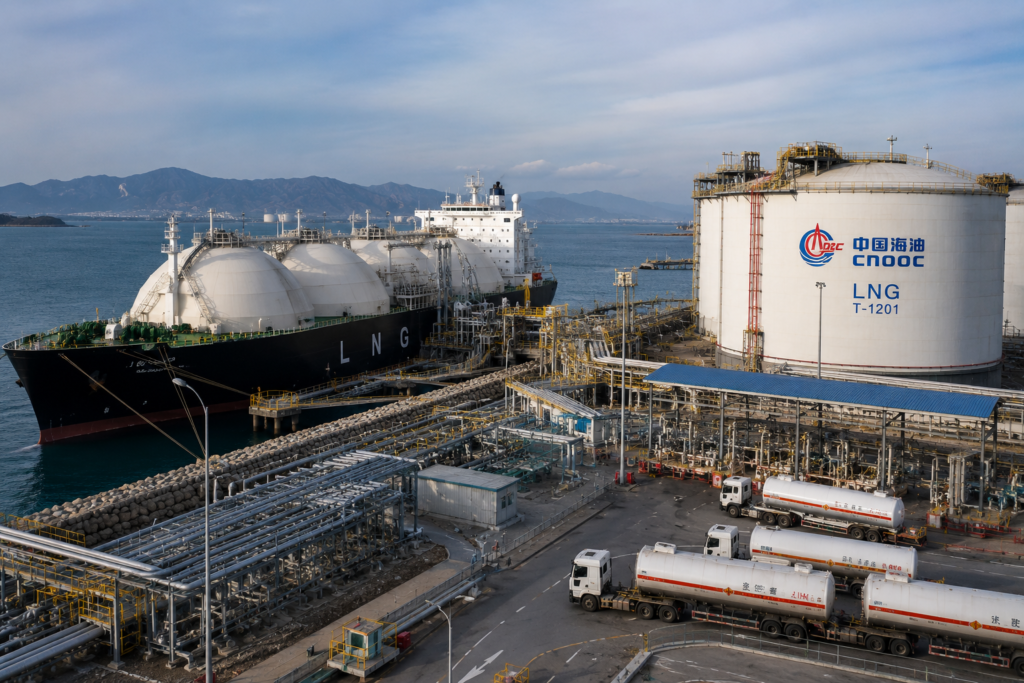
China’s LNG buying rebounds at a particularly significant moment for global energy markets, drawing attention from analysts, commodity traders, and policymakers worldwide. As temperatures rise across Asia during peak summer months, electricity demand in China has accelerated sharply, forcing the country to increase purchases of liquefied natural gas to maintain grid stability and meet industrial consumption requirements. The return of aggressive Chinese LNG procurement activity demonstrates how rapidly shifting seasonal demand patterns can reshape global fuel markets, particularly when the world’s second-largest economy begins competing for supply cargoes after periods of relatively restrained purchasing activity.
For much of the past year, global observers noted moderation in China’s import behavior due to slower economic growth patterns, increased domestic coal production, and stronger renewable energy generation capacity. However, summer power demand has once again revealed the structural reality of China’s energy consumption model. Despite enormous investments in renewable infrastructure, the country continues relying heavily on imported fossil fuels whenever electricity demand spikes beyond normal grid capacity. This renewed purchasing activity is becoming one of the clearest indicators that China’s energy transition remains far more complex than many long-term projections previously suggested.
Every summer, China experiences extraordinary pressure on its electricity generation network as residential cooling demand rises dramatically across densely populated urban regions. Air conditioning usage in major industrial centers contributes significantly to national electricity consumption, forcing utility operators to rapidly secure sufficient fuel resources to avoid power shortages. This year, particularly intense heat conditions have amplified demand pressures, making LNG imports increasingly important within the national energy mix.
China’s energy consumption patterns remain among the most complex in the world because industrial manufacturing activity, household demand, infrastructure development, and export-oriented production all simultaneously compete for electricity resources. During these peak demand cycles, renewable generation sources such as solar and wind often cannot independently provide sufficient reliability because output fluctuates according to environmental conditions. As a result, LNG-powered electricity generation facilities become critical balancing mechanisms capable of stabilizing supply when renewable output proves inconsistent.
The latest purchasing rebound demonstrates how seasonal energy consumption remains a dominant driver influencing liquefied natural gas markets worldwide. As China increases imports, competition intensifies among Asian buyers seeking similar cargoes, creating ripple effects across pricing benchmarks in Europe and emerging economies dependent on imported energy supplies.
China has spent years attempting to diversify its energy infrastructure away from overwhelming dependence on coal-fired electricity generation. Although coal remains deeply embedded within the country’s industrial foundation, natural gas increasingly occupies a strategic middle ground between traditional fossil fuels and long-term renewable ambitions. LNG imports allow Chinese authorities to reduce local pollution levels while preserving dispatchable electricity generation capacity capable of responding quickly during consumption surges.
Natural gas also provides significant flexibility advantages compared with large-scale renewable systems. Unlike solar farms or wind installations dependent on weather conditions, gas-fired plants can increase output immediately when demand unexpectedly rises. This operational advantage becomes especially valuable during summer months when regional electricity consumption often exceeds forecasts.
China’s LNG buying rebounds because policymakers recognize this flexibility advantage. Although government officials continue publicly emphasizing carbon reduction commitments, operational realities frequently require prioritizing immediate energy security over long-term emissions targets whenever grid stability becomes threatened.
The Chinese economy continues depending heavily on energy-intensive industrial production across manufacturing, construction, steelmaking, petrochemicals, and export-oriented industrial operations. Even moderate improvements in economic output can rapidly increase electricity demand due to the scale of China’s industrial infrastructure. As economic recovery gradually strengthens, demand for imported LNG naturally follows.
Global commodity pricing conditions also influence purchasing decisions. Buyers often increase procurement when pricing conditions become relatively attractive compared with previous market volatility periods. LNG traders carefully monitor fluctuations in benchmark Asian spot prices because small pricing adjustments can significantly alter procurement strategies among major importers like China.
Beyond pricing considerations, strategic inventory management also drives purchasing rebounds. Chinese energy planners frequently build reserves ahead of anticipated demand peaks, ensuring adequate supply availability during unexpected disruptions or prolonged heat events. This procurement behavior often appears sudden to external observers, but internally it reflects calculated risk management within one of the world’s largest energy-consuming economies.
China frequently leads global renewable energy investment rankings, installing solar farms, hydroelectric projects, battery storage systems, and offshore wind capacity at remarkable speed. However, infrastructure expansion alone has not eliminated dependence on imported fossil fuels. The challenge lies not in total installed renewable capacity but in grid integration efficiency and consistency of power delivery.
Renewable energy limitations become particularly visible during seasonal demand extremes. Solar production naturally declines during nighttime peak cooling hours, while wind generation remains inconsistent depending on atmospheric conditions. Battery storage technology continues improving but has not yet reached sufficient scale to replace dispatchable fuel generation during prolonged demand spikes affecting entire industrial provinces.
This creates a persistent structural gap between renewable ambitions and operational energy realities. China’s LNG buying rebounds precisely because the renewable transition remains incomplete, forcing policymakers to supplement clean energy growth with traditional fuel imports whenever electricity demand intensifies beyond renewable production capability.
International LNG markets remain highly sensitive to Chinese import behavior because China ranks among the world’s largest buyers of liquefied natural gas cargoes. Even moderate increases in purchasing activity can tighten available supply conditions across global trading networks. Suppliers in Qatar, Australia, the United States, and Southeast Asia carefully monitor Chinese procurement behavior because it directly influences shipping schedules and price expectations.
European buyers also watch these developments closely. In recent years, Europe increased LNG dependence following major supply disruptions affecting pipeline imports from traditional suppliers. If China aggressively returns to international spot markets during summer demand surges, competition for available cargoes intensifies significantly. This can raise procurement costs for European utilities simultaneously managing their own storage requirements ahead of winter heating seasons.
Asian importers including Japan, South Korea, and India face similar pricing pressures whenever Chinese demand accelerates unexpectedly. The interconnected nature of LNG trading means one nation’s seasonal purchasing decisions increasingly influence global market dynamics far beyond domestic consumption patterns.
Energy security remains one of the most important strategic priorities within Chinese economic planning. Government leadership recognizes that sustained economic growth requires uninterrupted fuel access regardless of geopolitical tensions, commodity volatility, or supply chain disruptions. LNG imports represent one important component within a much broader national strategy focused on diversification of fuel sources.
Unlike oil imports concentrated through vulnerable maritime chokepoints, LNG supply contracts often provide greater geographic diversification opportunities. China increasingly secures long-term supply agreements with producers worldwide to reduce exposure to regional disruptions affecting any single supplier network.
The rebound in LNG buying therefore reflects more than seasonal power demand. It highlights ongoing policy commitments centered around ensuring national energy resilience in an increasingly uncertain geopolitical environment. Even as renewable energy investments accelerate, strategic dependence on imported gas remains deeply integrated into long-term economic planning frameworks.
Much of the global climate discussion assumes rapid transitions away from fossil fuel dependence. China’s LNG purchasing rebound demonstrates that real-world energy transitions rarely follow idealized projections. Building renewable infrastructure represents only one part of transformation. Modernizing grid systems, developing storage capacity, improving transmission networks, and ensuring stable industrial electricity supply require decades rather than years.
China’s continued fossil fuel imports reveal a broader global lesson regarding realistic energy transition timelines. Economic development priorities, industrial competitiveness, and national energy security frequently slow the pace of aggressive decarbonization efforts even in countries publicly committed to ambitious climate goals.
Natural gas increasingly functions as a transitional fuel bridging current industrial requirements with future renewable systems. While environmental advocates often focus on reducing fossil fuel consumption immediately, policymakers responsible for national infrastructure frequently prioritize stability, affordability, and supply reliability above ideal transition speed targets.
The fact that China’s LNG buying rebounds during periods of elevated summer power demand sends a powerful signal to global energy markets. It confirms that despite substantial renewable investment, fossil fuels remain deeply embedded within the operational foundation of the world’s largest industrial economies. LNG markets will continue experiencing significant volatility whenever major importers adjust procurement strategies according to seasonal consumption changes.
Investors, commodity traders, and energy producers increasingly recognize that global energy transition narratives often overlook operational complexities influencing real-world demand patterns. China’s behavior illustrates how countries pursuing aggressive renewable growth strategies may still require large-scale fossil fuel imports for decades while infrastructure transitions gradually unfold.
Looking ahead, continued growth in electricity demand driven by industrial expansion, urban development, electric vehicle adoption, artificial intelligence infrastructure, and rising living standards will likely keep LNG demand elevated longer than many market forecasts currently anticipate. China’s latest purchasing rebound therefore represents more than temporary summer demand pressure. It serves as a reminder that global energy transformation remains an evolutionary process shaped by economic realities, technological limitations, and the constant balancing act between sustainability goals and practical energy security requirements.
China’s LNG buying rebounds during a period when global markets increasingly debate the future of fossil fuels, demonstrating that modern economies cannot transition away from traditional energy systems overnight. Rising summer power demand has once again exposed structural limitations within renewable infrastructure and reinforced natural gas’s role as an essential balancing fuel. As China continues navigating the complex path between climate commitments and economic growth, global energy markets should expect ongoing volatility, sustained LNG demand, and continued evidence that the world’s energy transition will be defined less by idealism and more by operational reality.