
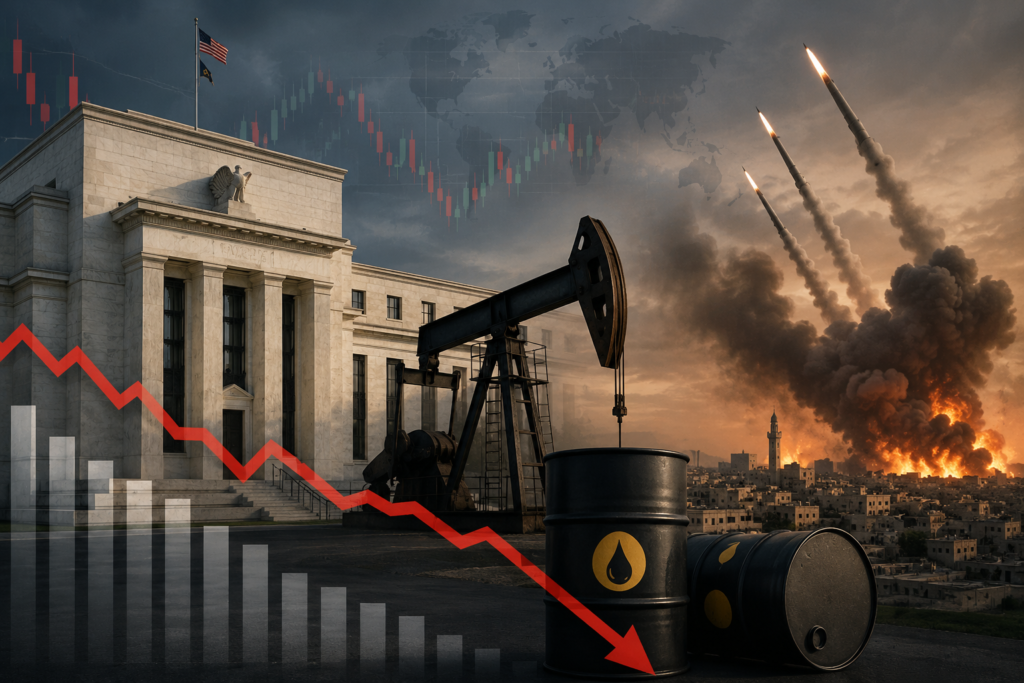
The global energy market has once again been forced to balance economic fundamentals against geopolitical uncertainty as renewed military tensions involving Iran return to the spotlight. Although conflicts in the Middle East often trigger expectations of sustained increases in crude oil prices, the latest outlook from the U.S. Federal Reserve presents a more measured assessment. The Fed oil prices Iran war narrative has attracted considerable attention because it combines two powerful market forces that frequently move in opposite directions. On one hand, geopolitical risks threaten global oil supply and increase volatility across commodity markets. On the other, slowing demand growth, expanding production outside OPEC+, and moderating inflation continue to place downward pressure on energy prices. This contrast has created an important debate among investors, policymakers, and businesses trying to understand whether recent price increases represent the beginning of a longer rally or simply another temporary reaction to geopolitical headlines.
Federal Reserve officials have repeatedly emphasized that monetary policy decisions depend on broad economic conditions rather than isolated market events. While conflicts involving major oil-producing regions inevitably influence commodity markets, policymakers generally focus on whether those shocks produce persistent inflation rather than temporary price spikes. Historical experience shows that oil markets often react sharply during the early stages of geopolitical crises before gradually returning to levels supported by supply and demand fundamentals. This pattern explains why many economists believe current crude oil prices may eventually stabilize even if regional tensions remain elevated.
Iran occupies a strategically important position in global energy markets because of its location near the Strait of Hormuz, one of the world’s busiest maritime oil transport corridors. Roughly one-fifth of internationally traded crude oil passes through this narrow waterway, making it one of the most significant chokepoints in global energy logistics. Whenever military activity increases around the region, traders immediately begin pricing additional geopolitical risk into oil futures.
However, history demonstrates that the size and duration of oil price increases depend less on political headlines and more on whether physical oil supplies are actually disrupted. Numerous geopolitical confrontations during the past two decades generated temporary rallies that faded once exports continued without significant interruption. Market participants understand this distinction well. Investors now react not only to news of conflict but also to shipping activity, tanker insurance costs, refinery demand, and production data from major exporting countries.
This explains why recent increases in crude oil prices have remained relatively restrained compared with previous Middle Eastern conflicts. While uncertainty undoubtedly adds a risk premium, traders continue monitoring actual supply conditions rather than assuming every political escalation will automatically reduce global exports.
One of the strongest arguments supporting the Federal Reserve’s relatively optimistic outlook is the continued resilience of global oil supply. Production from the United States remains historically strong, while output from countries outside the Middle East has helped diversify worldwide supply sources. In addition, OPEC+ continues managing production carefully to balance market stability against price objectives.
Outside the traditional producing regions, investment in offshore developments, shale production, and enhanced recovery technologies has increased the flexibility of global supply chains. This diversification reduces the probability that a single regional conflict will trigger the type of prolonged shortages experienced during earlier decades.
Demand conditions also play an important role. Economic growth has moderated across several advanced economies, while improvements in vehicle efficiency, renewable energy deployment, and industrial energy management have gradually reduced the intensity of oil consumption. Although global demand continues expanding, the pace has slowed compared with previous economic cycles. These structural changes help explain why many analysts believe that Federal Reserve oil forecasts remain grounded in realistic supply-demand expectations rather than excessive optimism.
For the Federal Reserve, oil prices matter primarily because of their influence on inflation. Higher fuel costs increase transportation expenses, manufacturing input prices, and household energy bills. Those increases can spread throughout the economy if businesses pass additional costs on to consumers.
Nevertheless, central bankers distinguish between temporary commodity price movements and sustained inflationary pressures. A brief increase in gasoline prices caused by geopolitical uncertainty does not necessarily justify changes in interest rate policy. Instead, policymakers examine whether higher energy costs begin influencing wage negotiations, consumer expectations, and broader pricing behavior.
This distinction has become increasingly important following the inflation surge experienced over the past several years. The Federal Reserve remains cautious but recognizes that supply-driven price shocks often fade once markets adjust. Unless the renewed Iran conflict significantly disrupts physical oil exports or damages critical energy infrastructure, many economists believe the inflationary effects could remain manageable.
Financial markets continuously evaluate probabilities rather than certainties. Current oil prices suggest investors recognize geopolitical dangers while also acknowledging the resilience of modern energy supply chains. Shipping companies continue operating through major export routes, strategic petroleum reserves remain available in several countries, and many importing nations have diversified their crude sourcing over recent years.
These factors help explain why the Iran conflict energy markets narrative has not produced the dramatic price spikes witnessed during previous global supply crises. Traders understand that speculation alone cannot sustain elevated oil prices if inventories remain adequate and production continues meeting demand.
Furthermore, technological improvements in logistics, storage, and energy trading have increased market flexibility. Real-time shipping data, advanced inventory management, and sophisticated financial hedging allow businesses to respond more effectively to short-term disruptions than in previous decades.
Despite the Federal Reserve’s confidence that oil prices may moderate over time, the possibility of a more severe geopolitical disruption cannot be ignored. Energy markets have repeatedly demonstrated that seemingly localized conflicts can escalate rapidly when they involve major oil-producing regions or critical shipping corridors. Iran remains one of the most influential countries in the Middle East energy landscape, and any event that significantly restricts exports or threatens commercial shipping through the Strait of Hormuz would likely alter market expectations almost immediately. Approximately one-fifth of globally traded crude oil passes through this narrow waterway, making it one of the world’s most strategically important maritime routes. A prolonged disruption would not only tighten global crude supplies but also increase freight costs, insurance premiums, and delivery times for refiners across Asia and Europe.
Unlike short-lived geopolitical events that generate temporary price spikes, a sustained interruption to oil flows could reshape the balance between supply and demand for months rather than weeks. Such a scenario would likely challenge the current assumption that oil prices will gradually cool and could force policymakers to reassess inflation forecasts. For now, however, physical exports continue moving through regional infrastructure, and market participants are treating recent tensions as manageable rather than catastrophic. That distinction explains why crude oil prices have remained volatile without entering the type of prolonged rally seen during previous global supply crises.
Financial markets rarely respond to headlines alone. Instead, investors evaluate the probability that geopolitical developments will translate into measurable changes in physical supply. Current pricing suggests traders believe the risk premium attached to the Iran conflict remains limited because global production capacity outside the region continues to provide a cushion against unexpected disruptions. Strong output from the United States, Brazil, Guyana, and Canada has diversified the global supply base, reducing dependence on any single producing region.
Another reason markets remain relatively calm is the availability of strategic petroleum reserves and emergency response mechanisms developed after earlier energy crises. Many consuming nations have strengthened inventory management policies, allowing governments and refiners to respond more effectively to temporary supply interruptions. This preparedness helps reduce panic buying and limits extreme price volatility.
At the same time, oil demand growth has moderated compared with previous years. Slower economic expansion in several major economies, combined with gains in energy efficiency and the gradual adoption of renewable technologies, has softened consumption growth. While global demand continues to increase, it is doing so at a pace that allows producers greater flexibility in balancing supply. These underlying fundamentals reinforce the Federal Reserve’s expectation that current price pressures may ease if geopolitical risks do not intensify.
Energy prices influence almost every sector of the economy, making the Federal Reserve’s outlook particularly important for businesses and consumers alike. Fuel costs affect transportation, manufacturing, agriculture, aviation, shipping, logistics, and retail operations. When crude oil prices rise sharply, companies often face higher operating expenses, forcing some to absorb lower profit margins while others pass additional costs to customers.
Consumers experience these effects through higher gasoline prices, increased utility bills, and rising prices for goods transported over long distances. Persistent energy inflation can reduce household purchasing power and weaken consumer confidence, ultimately slowing economic activity. However, if oil prices stabilize as the Federal Reserve expects, businesses may benefit from improved cost predictability while households gain relief from inflationary pressures.
For corporate decision-makers, stable energy prices also improve investment planning. Manufacturers can better forecast production costs, airlines can manage fuel budgets with greater confidence, and logistics providers can negotiate transportation contracts without accounting for extreme price volatility. This environment supports broader economic stability and allows companies to focus on long-term growth rather than short-term crisis management.
The relationship between geopolitical events and commodity markets has become increasingly complex. Modern energy markets are influenced not only by production volumes but also by financial trading, technological innovation, strategic reserves, transportation infrastructure, and government policy. As a result, political tensions alone no longer determine long-term pricing trends.
The current situation reflects that reality. Investors acknowledge the risks associated with renewed conflict involving Iran, yet they also recognize that global oil production remains relatively resilient. Producers have diversified supply sources, shipping networks have adapted to regional challenges, and consuming nations have strengthened emergency preparedness. These developments have increased the energy market’s ability to withstand temporary disruptions without triggering prolonged shortages.
Nevertheless, uncertainty remains a defining characteristic of global commodity markets. Any escalation affecting major export infrastructure, shipping routes, or regional security could rapidly change market sentiment. Policymakers, traders, and businesses will therefore continue monitoring developments closely while weighing geopolitical headlines against broader economic indicators.
The debate surrounding Fed oil prices Iran war expectations ultimately highlights the tension between geopolitical uncertainty and economic fundamentals. The Federal Reserve believes that current oil price pressures are unlikely to evolve into sustained inflation unless supply disruptions become severe or prolonged. Market behavior so far appears broadly consistent with that assessment, as traders have added a geopolitical risk premium without pricing in a full-scale supply crisis.
For businesses operating in energy-intensive industries, the coming months will require careful monitoring of both economic data and geopolitical developments. Procurement strategies, fuel hedging programs, and operational planning should remain flexible enough to respond to changing market conditions while avoiding unnecessary reactions to short-term volatility.
The global oil market has repeatedly shown its ability to absorb political shocks when production remains stable and alternative supplies remain available. At the same time, history demonstrates that geopolitical events can escalate unexpectedly, making risk management an essential part of every energy strategy. Whether oil prices ultimately cool as the Federal Reserve expects or rise in response to renewed disruptions will depend less on speculation and more on tangible changes in production, exports, shipping activity, and global demand.
For now, cautious optimism defines the market. Investors continue watching developments in the Middle East while recognizing that resilient supply chains, diversified production, and disciplined monetary policy have strengthened the global economy’s ability to withstand energy shocks. The balance between these competing forces will shape crude oil prices, inflation, and economic growth throughout the remainder of the year.
© 2026 Vastly. All rights reserved.