
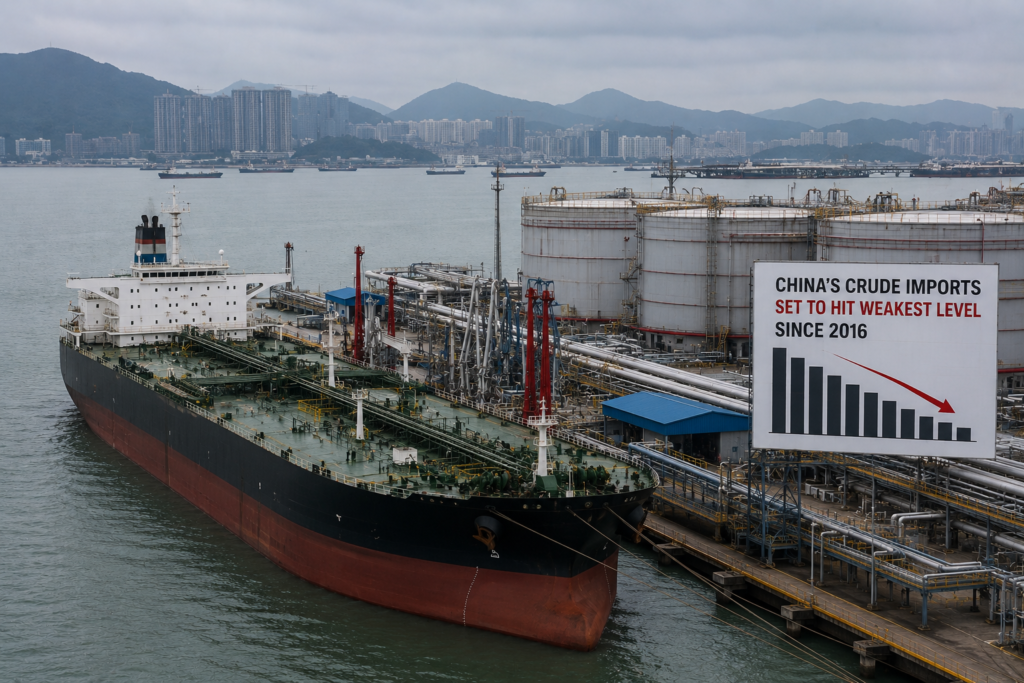
China’s crude oil imports moving toward their weakest level since 2016 is becoming one of the most closely watched developments in global commodity markets. For nearly two decades, China has functioned as one of the primary engines driving international oil demand growth, influencing pricing benchmarks, supply agreements, refining investments, and geopolitical energy relationships across multiple regions. When the world’s second-largest economy begins significantly reducing crude purchases, it sends an immediate signal that deeper structural shifts may be taking place within both domestic economic conditions and broader global energy systems.
The significance of this trend extends well beyond simple import statistics. Declining import volumes reflect changes occurring across industrial production, consumer demand, transportation activity, refinery operations, and long-term energy strategy planning. Investors and policymakers are increasingly analyzing whether this slowdown represents temporary weakness caused by economic conditions or whether China is entering a more permanent phase of lower fossil fuel dependence. In either case, reduced Chinese buying activity carries major implications for oil-producing nations and international energy markets that have historically relied on strong Chinese demand to maintain price stability.
For years, China has stood at the center of global oil consumption growth. Rapid industrialization, urban expansion, infrastructure development, and rising household consumption created enormous demand for imported crude oil. As domestic production struggled to keep pace with economic expansion, China increasingly turned toward international suppliers across the Middle East, Russia, Africa, and Latin America to secure long-term energy resources necessary for sustaining growth.
During the previous decade, Chinese import demand often served as one of the strongest indicators influencing international oil prices. Producers monitored Chinese purchasing behavior carefully because relatively small shifts in import volumes frequently triggered substantial price volatility across global crude benchmarks. The country’s massive refining capacity, expanding petrochemical sector, and growing transportation network ensured continued dependence on imported fossil fuels for much of its economic rise.
The current decline therefore represents an important break from historical patterns. When China crude oil imports begin falling toward levels not seen since 2016, analysts immediately recognize that fundamental changes may be occurring within one of the world’s most important energy-consuming economies.
One of the most immediate explanations behind falling import levels is the gradual slowdown affecting China’s broader economic performance. Manufacturing activity has experienced periods of weaker output, infrastructure development has moderated compared with previous expansion cycles, and consumer spending growth has faced increasing uncertainty across several sectors. Because industrial production remains heavily dependent on petroleum products, slower economic activity naturally reduces crude demand.
Large-scale manufacturing operations across steel production, construction materials, automotive assembly, and export-oriented industrial sectors consume enormous energy volumes daily. When these industries begin operating below expected capacity, fuel demand contracts rapidly. This creates immediate downward pressure on refinery purchasing behavior as crude inventories remain sufficient for lower production requirements.
Reduced industrial demand also affects transportation fuel consumption. Slower trade volumes reduce trucking activity, shipping logistics requirements, and diesel consumption across commercial supply networks. The combined effect gradually lowers overall national crude demand, directly influencing import behavior across international purchasing agreements.
Another important factor influencing lower import levels involves China’s efforts to maximize domestic production capacity wherever economically viable. While domestic reserves cannot fully replace foreign sourcing requirements, government-supported production expansion helps reduce immediate import dependence under certain market conditions.
China has spent years encouraging state-owned energy companies to improve extraction efficiency from existing fields while exploring new production opportunities capable of strengthening long-term energy security. Although domestic production remains limited relative to total national demand, even modest increases can reduce import requirements during periods of slower economic activity.
Strategic petroleum reserve management also affects purchasing patterns. China regularly adjusts crude buying volumes depending on reserve capacity, market pricing conditions, and long-term geopolitical considerations. During periods when reserves remain sufficiently stocked, import volumes often moderate temporarily without immediately indicating permanent demand destruction.
This means falling imports may partially reflect tactical purchasing decisions rather than simple consumption decline alone. However, when combined with economic softness and renewable expansion, the broader trend becomes increasingly significant.
Because China represents one of the world’s largest oil importers, declining demand creates substantial consequences for international producers. Major exporters such as Saudi Arabia, Russia, Iraq, and Brazil depend heavily on stable Asian demand growth to maintain export revenues.
Lower Chinese purchasing activity can increase supply availability across global markets, placing downward pressure on benchmark oil prices. When supply begins exceeding expected demand growth, producers often face difficult decisions involving production cuts, pricing adjustments, and renegotiation of long-term supply contracts.
Oil-exporting economies closely monitor Chinese demand indicators because future fiscal planning often depends on assumptions regarding continued Asian consumption growth. If China enters a prolonged period of weaker crude demand, international producers may need to diversify export strategies more aggressively toward alternative markets.
Commodity traders similarly react quickly when Chinese import trends weaken unexpectedly. Price expectations adjust almost immediately because demand forecasts remain central to short-term oil market valuations worldwide.
China’s energy security strategy extends beyond simple import volumes. The country increasingly prioritizes diversified supply chains designed to minimize geopolitical vulnerabilities. Long-term agreements with suppliers across multiple regions reduce dependence on any single exporting nation while protecting against future supply disruptions caused by sanctions, conflict, or shipping instability.
Changing geopolitical relationships also influence procurement behavior. Energy imports increasingly intersect with broader diplomatic strategy, infrastructure investment initiatives, and regional trade partnerships. This means crude purchasing decisions are no longer driven purely by market economics but increasingly shaped by strategic national security considerations.
As global supply chains become more politically sensitive, fluctuations in Chinese crude buying behavior may increasingly reflect geopolitical positioning rather than purely domestic consumption changes. Investors now examine these import trends not only through economic frameworks but also through broader international policy developments affecting future supply relationships.
China’s industrial economy itself is evolving. For years, heavy manufacturing sectors dominated economic expansion, requiring enormous energy inputs driven primarily by fossil fuels. Today, technology development, advanced manufacturing, digital infrastructure, artificial intelligence systems, and service-sector growth increasingly contribute larger shares of national economic output.
This structural transformation matters because newer industries often generate higher economic value while consuming comparatively less petroleum than traditional heavy industrial sectors. As economic composition gradually changes, energy consumption patterns naturally evolve alongside it.
Industrial demand shifts therefore represent another long-term factor influencing lower crude imports. Even if economic growth accelerates again, future energy consumption may not mirror previous decades because growth increasingly originates from sectors requiring fundamentally different energy inputs.
This transition complicates future forecasting models previously built around assumptions of continuously rising oil demand tied directly to GDP expansion.
China crude oil imports approaching their weakest level since 2016 may represent one of the most important warning signals currently emerging within international energy markets. The decline reflects overlapping factors including slower economic activity, expanding renewable energy adoption, strategic reserve management, domestic production improvements, changing industrial composition, and broader geopolitical recalibration.
For oil-producing nations, this trend introduces new uncertainty regarding long-term demand projections previously considered relatively stable. Global producers may increasingly face pressure to rethink investment strategies if Chinese demand no longer guarantees continuous growth supporting high production levels.
Energy investors should also recognize that global transition narratives are accelerating faster than many expected. While fossil fuels remain essential across industrial systems, structural demand growth patterns appear increasingly vulnerable to technological change and shifting economic priorities.
China’s crude oil imports falling toward their lowest level in nearly a decade reveals far more than temporary market softness. It highlights a rapidly evolving global energy landscape where economic restructuring, renewable technology adoption, geopolitical strategy, and energy security priorities increasingly shape fossil fuel demand patterns. The international oil market has long depended on Chinese growth as a stabilizing force, but these declining import trends suggest a future where traditional demand assumptions may no longer hold true. For global producers, investors, and policymakers, understanding this shift will be critical in preparing for an energy market entering a fundamentally new era of uncertainty and transformation.