
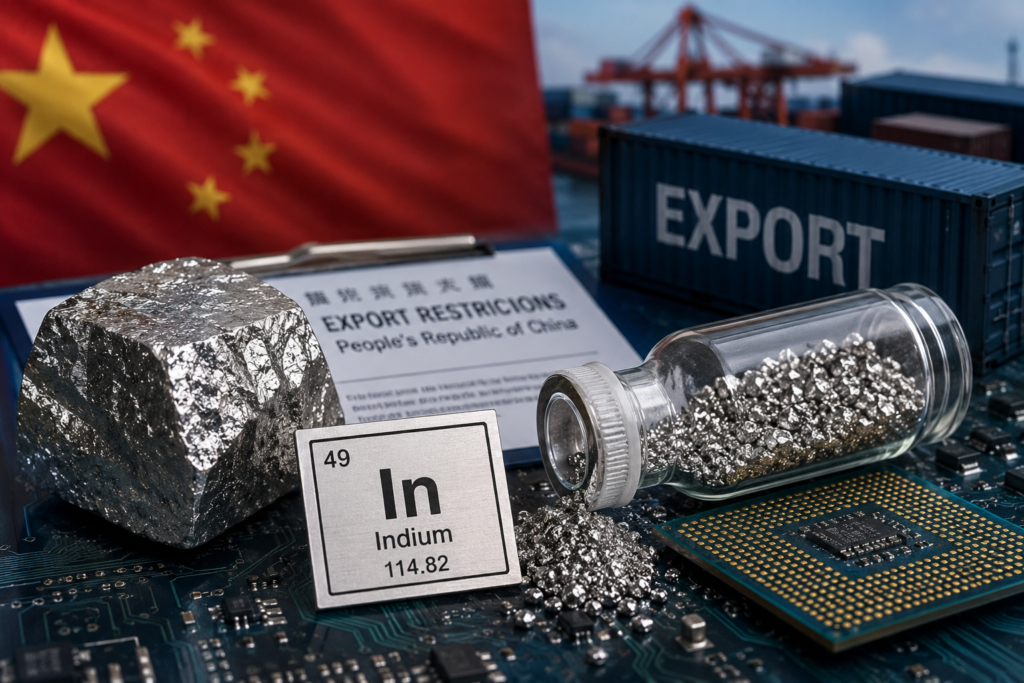
Artificial intelligence is rapidly transforming the global economy, but behind the accelerating race to build more powerful AI systems lies a supply chain challenge that many outside the technology sector rarely notice. The next generation of advanced processors, data center infrastructure, and semiconductor manufacturing depends not only on software innovation but also on access to highly specialized raw materials that make modern chip production possible. Among these materials, indium has emerged as one of the most strategically important yet often overlooked critical minerals in the technology sector. Recent moves by Beijing to increase oversight of indium exports have drawn global attention because they arrive at a moment when AI chip demand is growing at an unprecedented pace. As artificial intelligence infrastructure expands worldwide, China indium exports and AI chip demand are becoming increasingly interconnected issues shaping the future of technology manufacturing and global industrial competition.
China’s decision to intensify monitoring of indium shipments is not simply a domestic regulatory adjustment. It reflects broader geopolitical shifts surrounding critical mineral supply chains, semiconductor manufacturing security, and the growing competition among major economies seeking technological leadership. As governments and corporations invest billions into artificial intelligence development, access to specialized materials like indium is becoming just as strategically important as access to computing power itself.
Indium is a relatively rare metallic element that plays a critical role across multiple advanced manufacturing sectors, particularly electronics and semiconductor production. Although it does not receive the same public attention as materials like lithium, copper, or rare earth elements, indium is essential for manufacturing technologies that support modern digital infrastructure.
One of its most important applications involves indium tin oxide, a transparent conductive material widely used in touchscreens, flat panel displays, photovoltaic systems, and semiconductor manufacturing processes. Advanced processors, specialized integrated circuits, and certain chip fabrication systems depend on materials containing indium because of their unique conductive and thermal characteristics.
As semiconductor designs become increasingly complex, manufacturers require highly specialized materials capable of supporting faster processing speeds, greater energy efficiency, and increasingly compact circuit architecture. This growing technical complexity means materials once considered secondary industrial commodities now occupy critical positions within global technology manufacturing systems.
Indium’s role may appear niche, but without stable supply access, advanced electronics production faces substantial disruption risk.
Artificial intelligence has become one of the fastest-growing technology sectors in modern economic history. Major technology companies are investing heavily in AI infrastructure, building enormous data centers equipped with increasingly powerful processors capable of handling machine learning training workloads that demand extraordinary computational capacity.
Unlike traditional consumer electronics, AI computing systems require highly specialized semiconductor architectures designed specifically for parallel processing and accelerated data handling. Graphics processing units, advanced accelerators, neural processing systems, and custom AI chips require manufacturing processes operating at the absolute cutting edge of semiconductor engineering.
This rapid increase in AI chip demand has dramatically intensified competition throughout semiconductor supply chains. Manufacturers now face pressure not only to increase production capacity but also secure stable access to the raw materials required for advanced chip fabrication.
As artificial intelligence infrastructure expands globally, demand for materials supporting semiconductor manufacturing continues accelerating. Indium therefore becomes strategically important not because consumers recognize its name, but because the technology sector increasingly depends on it to sustain AI development momentum.
The AI revolution is fundamentally reshaping industrial demand for specialized minerals.
China occupies an exceptionally strong position within global critical mineral markets, particularly regarding materials essential for advanced manufacturing industries. The country controls significant portions of global production capacity across multiple strategically important minerals used in electronics, renewable energy infrastructure, battery manufacturing, and semiconductor production.
Indium represents one of these strategically important resources. Because much of the world’s refining and production capacity remains concentrated within China, many international manufacturers depend heavily on Chinese supply availability. This concentration creates structural vulnerability for countries whose technology industries rely on stable imports.
Beijing’s decision to strengthen scrutiny over indium exports highlights how governments increasingly recognize critical minerals as strategic assets rather than ordinary trade commodities. Materials once traded primarily according to standard commercial demand are now viewed through national security and industrial competitiveness frameworks.
China understands that supply chain control over critical minerals provides significant geopolitical leverage, particularly during periods of intensifying technological competition between major economic powers.
The importance of China indium exports and AI chip demand extends far beyond commodity markets because it directly influences who controls future technological infrastructure.
China’s increased oversight of indium exports appears closely connected to broader efforts aimed at protecting domestic strategic interests amid rising global competition in advanced technology development. Governments worldwide increasingly view semiconductor manufacturing capacity as a national security priority, and raw materials supporting chip production naturally become part of this larger strategic equation.
Export scrutiny does not necessarily indicate immediate supply restrictions, but tighter monitoring allows governments greater control over how critical materials move through international supply chains. By increasing regulatory oversight, Beijing gains greater visibility into export destinations, industrial demand patterns, and international dependency levels.
This strategy reflects a broader global trend. Governments increasingly use trade controls, export regulations, and industrial policy mechanisms to strengthen domestic competitive positioning within strategically sensitive sectors.
As artificial intelligence development accelerates, materials supporting chip manufacturing become increasingly valuable geopolitical assets. China’s actions suggest policymakers recognize the growing strategic importance of controlling supply chains connected to future technology leadership.
This is no longer simply commodity management. It represents strategic industrial positioning.
The semiconductor sector increasingly sits at the center of international geopolitical competition. Governments understand that economic leadership, defense capabilities, cybersecurity infrastructure, and technological innovation all depend heavily on access to advanced semiconductor manufacturing.
Supply chain concentration creates vulnerability. When a small number of countries control essential production capacity or raw materials, disruptions can quickly affect industries worldwide. The technology sector has already experienced significant semiconductor shortages over recent years, exposing how fragile these interconnected systems can become.
China’s tighter export oversight may intensify concerns among governments already seeking to reduce dependency on concentrated foreign supply chains. Countries investing heavily in domestic semiconductor manufacturing may accelerate efforts to diversify sourcing strategies for critical minerals.
This could lead to increased strategic competition over mining investments, refining infrastructure development, recycling technology innovation, and alternative supply chain creation.
Technology competition increasingly extends far beyond software development and hardware engineering. It now includes competition over physical access to the minerals enabling advanced industrial production itself.
Indium has quietly entered this geopolitical conversation.
Modern semiconductor manufacturing depends on extraordinarily complex international supply chains involving dozens of countries, specialized manufacturing facilities, advanced engineering systems, and highly refined industrial materials. Even minor disruptions affecting one specialized input can create delays affecting production timelines globally.
Technology manufacturers face growing concern over supply chain resilience because advanced chip fabrication depends on stable access to materials not easily substituted or rapidly sourced elsewhere. Building alternative production capacity for critical minerals often requires years of investment, infrastructure development, environmental permitting, and technical expertise.
The growing importance of artificial intelligence makes these vulnerabilities even more significant. AI development depends heavily on continuous semiconductor production growth capable of supporting expanding computational demand.
If supply constraints emerge around materials like indium, technology companies may face higher manufacturing costs, delayed production schedules, and reduced capacity expansion.
Supply chain resilience is becoming one of the defining challenges shaping the future of advanced technology manufacturing.
The world increasingly recognizes that technological innovation depends not only on software engineering but also physical industrial infrastructure.
Global competition surrounding critical minerals continues intensifying because modern technological development depends on access to increasingly specialized raw materials. Electric vehicles require lithium, cobalt, and nickel. Renewable energy infrastructure depends on copper and rare earth elements. Semiconductor manufacturing relies on materials like gallium, germanium, silicon, and indium.
Governments now understand these materials carry strategic importance comparable to traditional energy commodities such as oil and natural gas. Nations capable of controlling supply chains for critical industrial materials possess significant economic leverage.
China’s approach to indium reflects this broader strategic reality. Rather than treating critical minerals purely as export commodities, governments increasingly manage them within long-term industrial policy frameworks designed to strengthen national competitiveness.
Artificial intelligence infrastructure growth will likely accelerate this trend further because advanced computing systems depend on increasingly specialized manufacturing ecosystems.
The race for technological leadership increasingly overlaps with competition for industrial resource control.
Artificial intelligence development is expected to remain one of the most important drivers shaping global economic growth over the coming decade. Companies continue investing aggressively in AI platforms, machine learning systems, autonomous technologies, cloud computing infrastructure, and increasingly advanced semiconductor design.
Yet the future pace of AI development depends heavily on physical manufacturing capacity capable of producing specialized processors at enormous scale. Access to critical minerals supporting semiconductor fabrication therefore becomes a central factor influencing long-term industry growth.
China indium exports and AI chip demand illustrate how deeply interconnected global technology development has become with resource security and geopolitical strategy. Future technological leadership may depend not only on software innovation but also supply chain resilience and industrial self-sufficiency.
Governments seeking technology independence will likely accelerate domestic investment in critical mineral development, advanced manufacturing infrastructure, and strategic supply diversification.
Artificial intelligence may define the next era of economic competition, but access to critical minerals will increasingly determine who can sustain leadership within that transformation.
China’s decision to increase scrutiny over indium exports highlights a rapidly evolving reality shaping the global technology economy. As artificial intelligence development accelerates worldwide, access to specialized raw materials supporting semiconductor manufacturing has become strategically important on a global scale.
China indium exports and AI chip demand now represent more than an isolated trade issue. They reflect broader geopolitical competition surrounding critical minerals, technology manufacturing security, and the future balance of industrial power among major economies.
Indium’s growing importance demonstrates how modern technological innovation depends not only on software breakthroughs or hardware engineering but also stable access to highly specialized industrial materials. Governments and technology companies increasingly recognize that semiconductor supply chains represent both economic opportunity and strategic vulnerability.
The future of artificial intelligence infrastructure will depend as much on securing reliable access to critical minerals as it will on designing faster processors or building smarter algorithms. In the modern technology economy, control over industrial resources increasingly shapes the boundaries of innovation itself.
© 2026 Vastly. All rights reserved.