
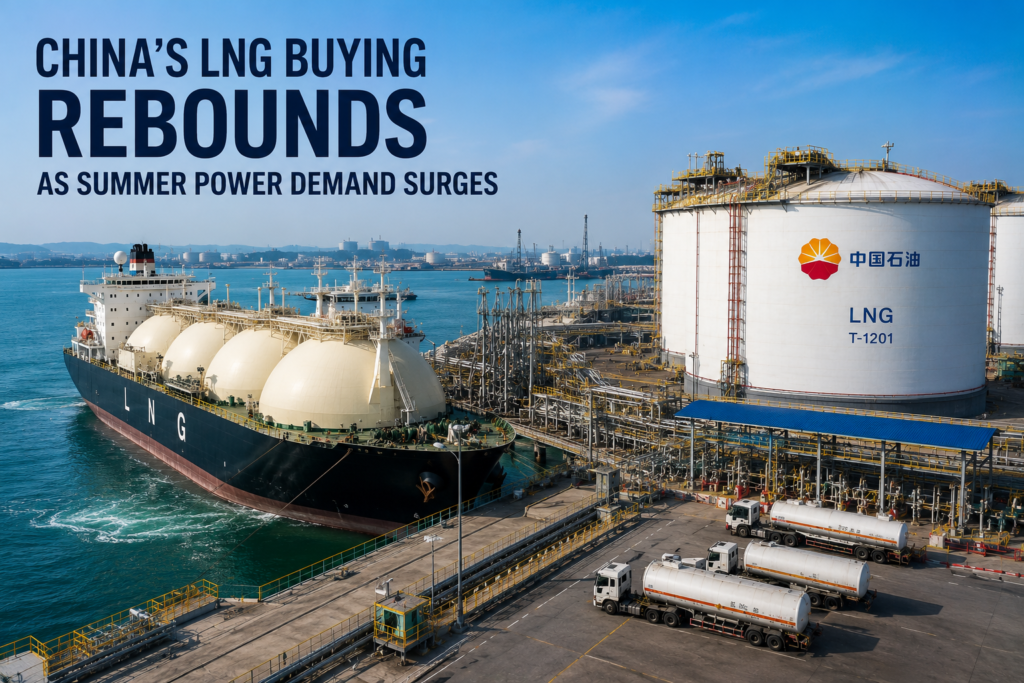
China’s renewed surge in liquefied natural gas purchasing has once again drawn global attention toward the country’s evolving energy strategy and the wider implications for international fuel markets. As extreme summer temperatures push electricity consumption higher across major industrial provinces, energy suppliers and policymakers are responding with aggressive procurement strategies to ensure uninterrupted power generation. The latest rebound in China LNG imports summer power demand reflects more than a seasonal buying trend. It highlights the continued importance of natural gas in balancing grid reliability, supporting industrial productivity, and protecting long-term energy security in the world’s second-largest economy. For global energy stakeholders, these developments offer valuable insight into how seasonal demand patterns inside China increasingly influence international fuel pricing, supply chain coordination, and broader geopolitical energy decisions.
China remains one of the largest energy-consuming nations in the world, and its purchasing behavior frequently creates ripple effects across global commodity markets. During summer months, electricity demand typically accelerates as households, businesses, and manufacturing facilities increase cooling consumption amid rising temperatures. Air conditioning usage alone places significant pressure on national power grids, particularly in heavily industrialized economic centers where electricity demand already operates near capacity. The renewed rise in LNG purchasing activity demonstrates how China continues relying on imported gas to support peak seasonal demand, especially when renewable generation capacity alone cannot stabilize sudden spikes in electricity consumption.
Liquefied natural gas has become a strategically important component of China’s long-term energy planning. While the country has aggressively invested in renewable energy infrastructure, including solar farms, wind generation projects, and hydroelectric facilities, natural gas continues serving as an essential bridge fuel capable of delivering reliable baseload power when renewable generation fluctuates. The growing scale of China LNG imports reflects this reality. Renewable infrastructure may provide long-term sustainability benefits, but immediate power stability during seasonal demand surges often depends on fossil fuel systems capable of responding quickly to changing consumption patterns.
China has spent years expanding LNG import terminals along its coastal provinces, increasing storage capacity, and strengthening transportation infrastructure connecting import facilities to domestic industrial centers. These investments reflect a clear strategic objective. Energy security remains central to economic stability, and access to diversified LNG supply channels allows China to reduce overdependence on coal while maintaining operational flexibility across its power sector. The latest summer purchasing rebound reinforces how LNG infrastructure development remains deeply connected to national economic priorities.
The current surge in purchasing activity cannot be understood without examining China’s enormous electricity demand during summer heatwaves. Rising temperatures significantly increase residential power consumption, but industrial demand remains an equally powerful driver. Manufacturing centers across provinces such as Guangdong, Jiangsu, and Zhejiang operate massive production networks supporting global electronics, automotive production, steel manufacturing, and chemical processing industries. Even small disruptions to electricity availability create economic consequences that extend beyond domestic markets.
Seasonal temperature spikes place extraordinary stress on regional utilities tasked with maintaining uninterrupted electricity delivery. During these periods, power providers frequently seek rapid access to fuel sources capable of supporting immediate generation requirements. Natural gas remains one of the fastest deployable solutions for balancing short-term supply gaps. As a result, summer power demand directly influences short-term LNG purchasing decisions, particularly when meteorological forecasts suggest extended heatwaves or unusually high cooling requirements.
Whenever China significantly increases LNG procurement activity, international markets immediately react. China is one of the world’s largest LNG importers, and sudden shifts in purchasing volume can tighten global supply availability, especially during periods when production capacity elsewhere remains constrained. Increased Chinese demand often forces competing buyers across Asia and Europe to adjust procurement strategies, creating upward pricing pressure across regional markets.
Countries such as Japan, South Korea, and India closely monitor Chinese LNG purchasing behavior because competition for available cargoes can quickly intensify during high-demand periods. When Chinese buyers return aggressively to the market, suppliers often redirect shipments toward higher-value contracts, influencing supply availability across neighboring economies. This creates an interconnected pricing environment where domestic weather conditions inside China influence fuel purchasing strategies thousands of miles away.
The current rebound highlights how global LNG markets remain highly sensitive to seasonal fluctuations within major importing economies. Energy traders continuously monitor Chinese procurement volumes because these purchasing decisions frequently shape short-term price movement across benchmark LNG trading hubs worldwide.
China’s recent LNG buying activity also reflects broader concerns surrounding national energy security. The country has spent years working toward reducing vulnerability associated with overdependence on individual fuel sources or politically sensitive supply routes. While renewable energy investments continue expanding rapidly, energy diversification remains a parallel priority.
Natural gas imports provide a valuable diversification mechanism. Unlike coal production, which faces increasing environmental scrutiny, LNG offers cleaner combustion characteristics while supporting reliable power generation. At the same time, imported LNG reduces pressure on domestic coal reserves and allows policymakers greater flexibility when balancing economic growth against emissions reduction objectives.
The concept of China energy security extends beyond environmental policy. Industrial productivity, manufacturing competitiveness, export reliability, and political stability all depend on consistent access to affordable electricity. The current LNG purchasing rebound reflects the reality that national energy resilience remains a priority regardless of longer-term renewable transition goals.
The increase in Chinese procurement activity arrives at a time when global LNG markets remain highly sensitive to supply-demand imbalances. LNG pricing depends heavily on contract timing, shipping logistics, regional demand cycles, and production output from major exporters including Qatar, Australia, and the United States. When a major buyer such as China suddenly increases purchasing activity, suppliers often gain stronger pricing leverage.
Asian LNG benchmark prices historically react quickly to Chinese demand fluctuations. Increased competition for cargoes pushes prices upward, creating cost pressure for utilities and industrial buyers across importing economies. This dynamic becomes particularly important during summer months when multiple Asian economies simultaneously experience elevated electricity demand.
Energy traders closely monitor whether the current rebound represents temporary seasonal buying or signals a broader shift toward sustained procurement growth. If elevated purchasing continues beyond peak summer demand, international LNG markets could experience prolonged pricing volatility extending into future quarters.
Despite aggressive renewable investment programs, China’s transition away from fossil fuels remains gradual rather than immediate. LNG occupies a unique role within this strategy because natural gas produces lower carbon emissions compared with coal while still providing dispatchable power generation capable of supporting industrial-scale electricity demand.
Renewable infrastructure development faces technical limitations that prevent immediate replacement of conventional energy systems. Solar generation declines after sunset. Wind production fluctuates according to weather conditions. Battery storage technology continues improving but remains insufficient to support nationwide industrial electricity requirements at massive scale. These limitations explain why LNG remains an important transitional fuel despite ambitious carbon reduction targets.
The latest China LNG imports summer power demand surge illustrates this balancing act. China continues expanding renewable infrastructure aggressively, yet immediate economic realities require dependable energy systems capable of maintaining uninterrupted industrial productivity regardless of weather variability.
Global LNG exporters carefully watch Chinese purchasing patterns because China increasingly determines demand trends shaping long-term production investment decisions. Major suppliers including Qatar, Australia, and the United States continuously adjust export strategies based on anticipated Asian demand growth.
If China maintains stronger LNG buying activity beyond summer demand cycles, exporters may accelerate production expansion projects designed to capture future market share. Shipping operators, storage terminal developers, and infrastructure investors also respond directly to changing procurement patterns originating from major Asian importers.
For energy producers worldwide, China’s current buying rebound offers a reminder that Asian demand growth remains one of the strongest forces influencing long-term LNG market economics.